The School’s New Computers
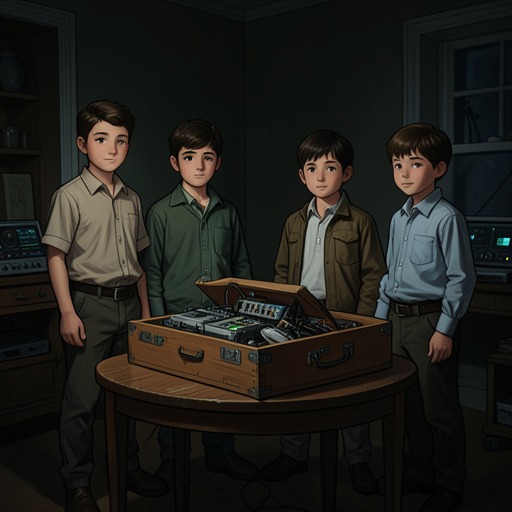
Sonne und BetonThe School’s New Computers begin as a promise of educational access and become the material center of an attempted theft. Announced as fifty new machines intended to bring practical computer instruction to the school, they are quickly recast by Lukas, Gino, Julius, and Sanchez as a source of quick money. The gap between the public purpose of the computers and the boys’ private plan gives the machines their defining role: they are both school equipment and tempting, conspicuous goods whose very newness makes them hard to dispose of.
Announcement and Intended Use
At a school assembly, Herr Schiezeth announces that Berlin is providing fifty new computers. The school is to receive them within days, and practical information-technology lessons are expected to begin the following week. He presents the equipment as preparation for working life, arguing that students should gain basic computer skills. The announcement is meant to be celebratory, but the noisy, joking crowd does not respond as he hopes. Its disorder makes the official promise feel less like a shared school milestone than a spectacle struggling to hold the students’ attention.
The visiting representative from the Bildungssenat des Landes Berlin is meant to speak after Herr Schiezeth. Instead, his attempt to address the assembly becomes comic disruption: he adjusts the microphone stand, returns to fetch an apple spritzer, and accidentally sprays the drink before knocking the stand to the floor. The computers are thus introduced amid a scene in which the institution’s planned ceremony repeatedly loses control. That contrast matters when the equipment is later treated not as a resource for lessons but as an opportunity for profit.
From School Resource to Target
The announcement travels from assembly news into a criminal proposal. Sanchez tells Lukas, Gino, and Julius that the school will receive fifty new PCs, complete with screens, keyboards, and mice, and proposes that they steal and sell them. The detail that the shipment is imminent gives the plan a deadline; its full package of peripherals also makes clear that the boys are imagining a large, valuable haul, not taking a single machine on impulse. Julius and Gino respond with enthusiasm, while Lukas questions whether Sanchez is serious and objects to breaking into their own school.
Julius offers a lock pick and boasts that it can open doors, cars, and cellars. Sanchez dismisses it by throwing down a large key ring. Julius immediately abandons the pick and asks whether the keys belong to the school; Sanchez answers with a wink. The exchange supplies the plan with a practical means of entry while also revealing how casually the boys treat the boundary between access and permission. The keys are more useful than Julius’s improvised tool, but their presence makes the proposed crime depend on school access already in their possession.
The Night Entry and Discovery
The group approaches the school on a Saturday night, in a residential area where there are no nearby bars or clubs and people are expected to be asleep. The quiet does not make the setting feel safe: it makes the boys more conspicuous. Sanchez has kicked out the lamp by the school gate, leaving them in darkness, and Julius explains that he has brought a blank-firing gun. Lukas recognizes that carrying it could turn the consequences of being caught into something much more serious. The machine theft is therefore accompanied from the start by a risk the group has no good reason to accept.
Julius sets out the route: Sanchez will unlock the gate, and they will pass the basketball courts to reach the door. At the side entrance near the seventh-year classrooms, Lukas worries about cleaners, a night watchman, motion sensors, and cameras. He also realizes that this entrance takes them past the caretaker’s room and cleaning-storage rooms, where someone might be present. Sanchez unlocks the door before Lukas can act on that second thought. The keys make entry possible, but they do not remove the uncertainty of what waits inside.
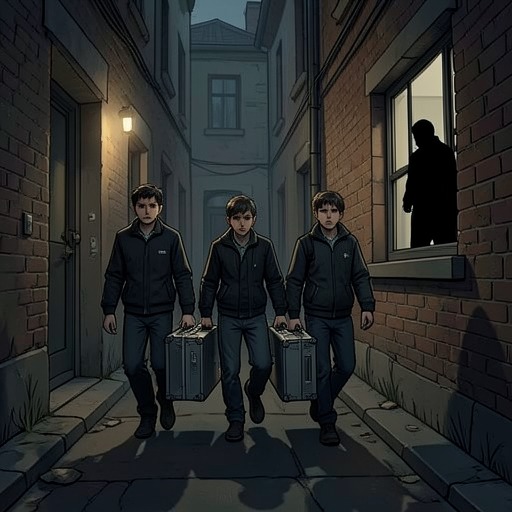
The boys initially search the storage area without finding the shipment. Julius kicks a box, spits on the floor, and throws a book against the wall as frustration builds. Sanchez then spots unopened cartons on the shelves, with computers and monitors pictured on them. Lukas estimates that there are about forty. The difference between that visible stock and the announced fifty remains unresolved in the scene; what is clear is that the boxes are new, identifiable, and stored together. Lukas takes a small step stool from the corner and passes the cartons down from the shelves, while Sanchez and Julius receive them and put them on the floor. The physical sequence turns the plan into action: the computers cease to be an announcement and become heavy objects that must be handled and carried.
The Computers Resist Resale
The boys’ expectation of easy money meets a problem specific to the computers. When Lukas speaks with a computer-shop worker, the worker explains that school machines are registered by code and can be traced. Unlike a phone that might be sold quickly, a stack of brand-new computers would draw suspicion, especially after news of a school burglary. The exchange reverses the boys’ fantasy of effortless profit: the features that make the shipment valuable also make it recognizable and difficult to sell.
At the shop, Lukas claims that the boys are twenty, although he knows that saying they are sixteen might get them turned away. The worker laughs, then points to the recent theft of a large quantity of computers from a school and the appearance of three students trying to sell brand-new machines. He asks whether they think he is stupid. The computers have not merely proved hard to sell in the abstract; their newness, quantity, and timing connect the would-be sellers to the burglary in the eyes of a possible buyer. Sanchez begins to deny that they come from a school, but the attempted transaction has already exposed the central weakness in the plan: these are not anonymous goods that can be separated from their origin simply by carrying them away.